Most executives already know what they should be working on: strategy, hiring, and the relationships that move the business forward. The problem is that none of it is due today, and almost everything else is.
That tension is exactly what the Franklin Covey Method was built to solve. At its center is the Covey Time Management Matrix, a four-quadrant grid that sorts every task by urgency and importance and steers you toward the work that matters before it becomes a crisis.
It's one of the most respected time management frameworks ever created. It also asks for something most executives can't provide on their own: a place to send urgent work that isn't theirs.
TLDR
- The Franklin Covey method pairs the Covey time management matrix with weekly, values-based planning to prioritize important work.
- Its payoff lives in Quadrant II, but urgent, low-value requests in Quadrant III crowd most executives out of it.
- A managed assistant absorbs Quadrant III work, so the time you set aside for Quadrant II stays protected.
What Is the Franklin Covey Method?
The Franklin Covey method is a time management system that connects your daily task list to your long-term values and goals. It combines two ideas: Stephen Covey's urgent-versus-important time matrix and the daily planning discipline of the Franklin Planner.
The two halves have different origins. Hyrum W. Smith created the Franklin Planner in 1984, naming it after Benjamin Franklin's habit of daily self-examination. Covey introduced his time matrix in The 7 Habits of Highly Effective People (1989) under Habit 3, "Put First Things First," and expanded on it in First Things First (1994). In 1997, Smith's Franklin Quest and the Covey Leadership Center merged to form FranklinCovey.
Franklin Covey time management works from the top down. You start with what matters to you, translate it into goals, and only then decide what belongs on today's list.
Bottom-up systems like the GTD method take the opposite route; they capture everything on your plate first and sort it afterward. Neither approach is wrong. But if your biggest problem is that important work keeps losing to urgent work, the Franklin Covey method is built for you.
The Four Quadrants of the Covey Time Management Matrix
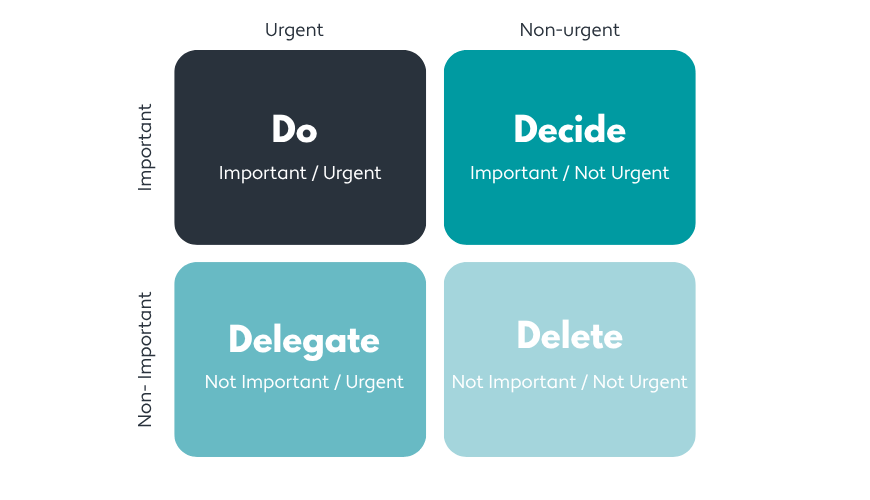
The Covey time management matrix sorts every activity along two axes: how urgent it is and how important it is.
Urgent tasks demand immediate attention. Important tasks advance your mission, your key roles, and your highest-priority goals. Combined, they produce Covey's four quadrants, which Franklin Covey labels Necessity, Effectiveness, Distraction, and Waste.
-
Quadrant I: Do → Crises, pressing problems, deadlines tied to major goals. Handle it now.
- Quadrant II: Decide → Strategic planning, relationship building, coaching, creative thinking. Schedule it and protect it.
- Quadrant III: Delegate → Most email, low-priority requests, meetings you don't need to attend, tasks others could handle. Minimize, decline, or delegate it.
- Quadrant IV: Delete → Busywork, unnecessary reports, habitual inbox checking. Eliminate it.
The real insight of the matrix is Quadrant II. Planning, prevention, and relationship building are never urgent until neglect turns them into Quadrant I emergencies, so every hour invested there means fewer fires later.
If the grid looks familiar, that's because Covey adapted it from a principle attributed to Dwight Eisenhower. The difference is emphasis. The Eisenhower Matrix is usually applied as a quick sort-and-decide tool, while Covey built an entire planning system around living in Quadrant II.
Learn more: The 12 Best Productivity Systems to Try →
How to Use the Franklin Covey Planning Process
The matrix tells you what matters. The planning process makes sure it actually lands on your calendar.
It works across three time horizons: your broad mission, your week, and your day.
- Define your mission and roles. Write a short personal mission statement, then list the key roles you play, such as executive, team leader, parent, or board member. Covey suggested capping the list at about seven roles to keep it manageable.
- Set weekly goals for each role. Before the week begins, choose up to three goals per role. These are your "big rocks," the Quadrant II priorities that won't happen unless you plan for them.
- Schedule the big rocks first. Block time for those goals before meetings and requests claim your calendar. If the big rocks don't go in first, they won't fit later.
- Plan and prioritize each day. Spend about 15 minutes each morning reviewing your calendar and building a prioritized task list. The classic Franklin approach ranks each task A (vital), B (important), or C (optional), then numbers tasks within each group: A1, A2, B1, and so on.
- Work the list in order. Start with A1 and move down. Anything unfinished carries forward into tomorrow's plan, where it gets re-ranked.
The layers depend on one another. Miss the weekly planning session, and your daily list quietly fills with whatever landed in your inbox overnight.
Why the Franklin Covey Method Breaks Down for Executives
The Franklin Covey method breaks down for executives because Quadrant III never stops refilling. You can plan a perfect week on Sunday night and lose it by Tuesday to a never-ending cascade of meeting requests, scheduling back-and-forth, and follow-ups someone needs right now.
The research reflects this. A FranklinCovey survey of more than 351,000 people found that respondents spent roughly 40% of their time on activities that weren't important.
Higher up the org chart, the pull gets stronger: Harvard Business School's study of CEO time use found that chief executives spent 72% of their working hours in meetings and about 36% of their time reacting to unfolding issues.
Covey's prescription for Quadrant III is to say no or delegate. For many executives, neither is realistic. Declining a client, a board member, or your own team usually isn't an option, and delegating requires someone to delegate to.
Without that person, Quadrant III work defaults back to you, and the hours you have to spend on that work cut into your Quadrant I or Quadrant II work.
That's the gap. The Covey time management matrix shows where your time should go but it can't create the capacity you need to actually to get it there.
Want to see where your hours actually go? Read our guide: How to Do a Time Audit at Work →
How a Managed Assistant Keeps You in Quadrant II
The fix is giving Quadrant III work somewhere to go besides your calendar.
A Prialto managed virtual assistant bridges the Quadrant III gap. A virtual assistant takes on exactly this category of work: the scheduling, inbox triage, meeting prep, and follow-up work that is urgent but doesn't require your judgment. Once "delegate it" is a real option, the Franklin Covey method works the way it was designed to.
While they're most focused on Quadrant III, your assistant supports every part of the system:
- Quadrant I: Clears the path during a crisis by rescheduling, pulling documents, and coordinating the people involved, so you can focus on the decision.
- Quadrant II: Guards the time you've blocked for big rocks, moving or declining conflicting requests before they ever reach you.
- Quadrant III: Owns the recurring requests outright (calendar coordination, routine email, travel, CRM updates, and follow-ups).
- Quadrant IV: Filters low-value noise out of your inbox so it stops competing for your attention.
- Weekly and daily planning: Prepares a week-ahead view and a daily briefing, so your 15-minute planning session starts with a clear picture.
Because Prialto is a managed service, you aren't recruiting and training an individual to make this work. Your Engagement Manager documents your preferences and trains your assistant on them. Trained backup support covers you when your assistant is out, so the system holds even when your week doesn't go to plan.
The result is simple. The hours you planned for Quadrant II go to the work only you can do.
What does a virtual assistant actually do? Get a full breakdown of virtual assistant tasks and projects →
Covey Time Management Matrix: Frequently Asked Questions
What are the four quadrants of the Covey time management matrix?
The four quadrants are Quadrant I (urgent and important, or Necessity), Quadrant II (important but not urgent, or Effectiveness), Quadrant III (urgent but not important, or Distraction), and Quadrant IV (neither urgent nor important, or Waste). Covey's core advice is to spend as much time as possible in Quadrant II, where planning, prevention, and relationship building happen.
Is the Covey time management matrix the same as the Eisenhower Matrix?
Both use the same four-quadrant grid. The Eisenhower Matrix is typically applied as a quick decision tool for sorting tasks into do, schedule, delegate, or drop. Covey built a full planning system around the grid, adding a personal mission, roles, and weekly goal-setting to keep you focused on Quadrant II. Read our guide to the Eisenhower Matrix →
What's the difference between the Franklin Covey method and GTD?
The Franklin Covey method is top-down: you start with values and goals, then decide what belongs on today's list. GTD is bottom-up: you capture every open task first, then clarify and organize it. Many executives combine the two, using GTD to manage incoming work and the Covey matrix to decide which items deserve their time.
What is Quadrant II in time management?
Quadrant II covers activities that are important but not urgent, such as strategic planning, coaching your team, building relationships, and learning. These tasks drive long-term results but rarely come with a deadline, so they get pushed aside unless you schedule them first.
Ready to Spend More Time in Quadrant II?
The Covey time management matrix shows you where your best hours belong. What most executives lack is the capacity to keep them there. Talk to us about how a Prialto assistant can take Quadrant III off your plate, so your weekly plan actually holds.