Twenty-five minutes. That's the premise of the Pomodoro method: pick one task, set a timer, and give it your full attention until it rings.
It sounds almost too simple to be impactful. Yet the technique has outlasted decades of productivity apps, and the research behind structured breaks is more favorable than you might expect.
For executives, the timer is the easy part. Minute nine, when the first "quick question" lands, is where their commitment to the process usually ends. It'll only take a couple of seconds, you think. But by the time you shift back to your initial task, the momentum is gone.
Here's how the method works, what the evidence says, and what it takes to make it hold up on a leader's calendar.
TLDR
- The Pomodoro method breaks work into 25-minute focus sprints, with short breaks between and a longer one after four.
- Studies of students suggest scheduled breaks reduce fatigue and distraction compared with breaking whenever you feel like it.
- For executives, the method stalls at its interruption rule, and a managed assistant is what keeps the timer running.
Table of Contents
- What Is the Pomodoro Method?
- How Does the Pomodoro Technique Work?
- Does the Pomodoro Method Actually Work?
- Why the Pomodoro Method Breaks Down for Executives
- How a Managed Assistant Keeps the Pomodoro Method Running
- Pomodoro Method: Frequently Asked Questions
- Ready to Protect Your Focus Time?
What Is the Pomodoro Method?
The Pomodoro method is a time management technique that splits work into 25-minute intervals of single-task focus, each followed by a short break. Each interval is called a pomodoro, and after four, you take a longer rest.
Francesco Cirillo developed the approach in the late 1980s as a university student. He named it after the tomato-shaped kitchen timer he used to track his study sessions (pomodoro is Italian for tomato).
The logic is straightforward. Most people can't sustain deep focus for hours at a stretch, and most of us are poor judges of when we need a break (especially executives). A fixed timer takes that decision off the table; you don't debate whether to keep going, because the clock has already decided.
Like the GTD method, the Pomodoro technique doesn't depend on any particular app. Cirillo still favors a mechanical timer and a sheet of paper, though a phone works just as well.
How Does the Pomodoro Technique Work?
The Pomodoro technique runs on a simple loop, but Cirillo's original version includes planning and tracking steps that most timer apps leave out. Here's the full cycle:
- Plan your day. Start with a "To Do Today" list of the tasks you intend to finish, in priority order. Many practitioners also estimate how many pomodoros each task will take.
- Set the timer for 25 minutes. Choose one task from the list and start the clock. One task, not three.
- Protect the pomodoro. In Cirillo's system, a pomodoro can't be split. If something interrupts you, either note it and handle it later, or abandon the pomodoro and start over. For interruptions from other people, he prescribes a four-part response: inform, negotiate, schedule, and call back. Keep this step in mind; it decides whether the method survives an executive's week.
- Take a short break. When the timer rings, stop (even mid-sentence) and step away for about five minutes. Stand up, stretch, look at something other than a screen.
- Take a longer break after four pomodoros. Every fourth cycle earns a 20- to 30-minute rest before the loop starts again.
- Record what you finished. Mark each completed pomodoro. Over time, the record shows how long your work actually takes, which makes tomorrow's plan more realistic.
The planning step is vital to success for executives doing high-impact, high-value work. If you aren't planning your day ahead, you risk wasting too much time on low-impact, low-value work. Prioritization is key.
Learn more: Best Productivity Systems: 12 Systems to Try Right Now →
Does the Pomodoro Method Actually Work?
The evidence is encouraging, though it hasn't been applied to executives at a high level.
-
In a 2023 study published in the British Journal of Educational Psychology, students who chose when to take breaks ended up studying in longer stretches. That pattern was associated with more fatigue and distraction, plus lower concentration and motivation, than students on a fixed Pomodoro-style schedule.
-
A 2025 scoping review in BMC Medical Education pointed in the same direction. Across the randomized trials it examined, structured Pomodoro intervals were linked to roughly 20% lower fatigue than self-paced breaks, and 88% of the studies reviewed reported positive outcomes.
The consistent pattern: the biggest Pomodoro technique benefits are less mental fatigue and fewer self-inflicted interruptions. The method works because it takes the "should I stop?" decision away from a tired brain.
Why the Pomodoro Method Breaks Down for Executives
Step three is where things fall apart. The Pomodoro method assumes you can hold most interruptions at bay for 25 minutes. For a leader, the interruptions are often the job itself.
Consider the volume. Microsoft's 2025 Work Trend Index found that among the most heavily pinged 20% of Microsoft 365 users, a meeting, email, or chat arrives roughly every two minutes during core work hours. At that pace, a single pomodoro faces about a dozen potential interruptions before the timer rings.
Cirillo's answer is the inform, negotiate, schedule, call back protocol.
-
Inform: Let your team know that you're currently in a work block via a response and calendar blocking.
- Negotiate: Ascertain the urgency of the ask and record the details.
- Schedule: If it's urgent, reschedule your focus block. If it's not urgent, provide them with a follow-up time.
- Call back: Once your Pomodoro block is over, reach back out.
This method ensures you guard the 25 minutes you're in while your inbox fills up behind you. (For a broader look at what erodes attention at work, see our guide on how to focus better at work.)
Pair the Pomodoro Method with the Eisenhower Matrix for Better Prioritization
For executives, we propose applying the Pomodoro Method alongside the Eisenhower Matrix for prioritization.
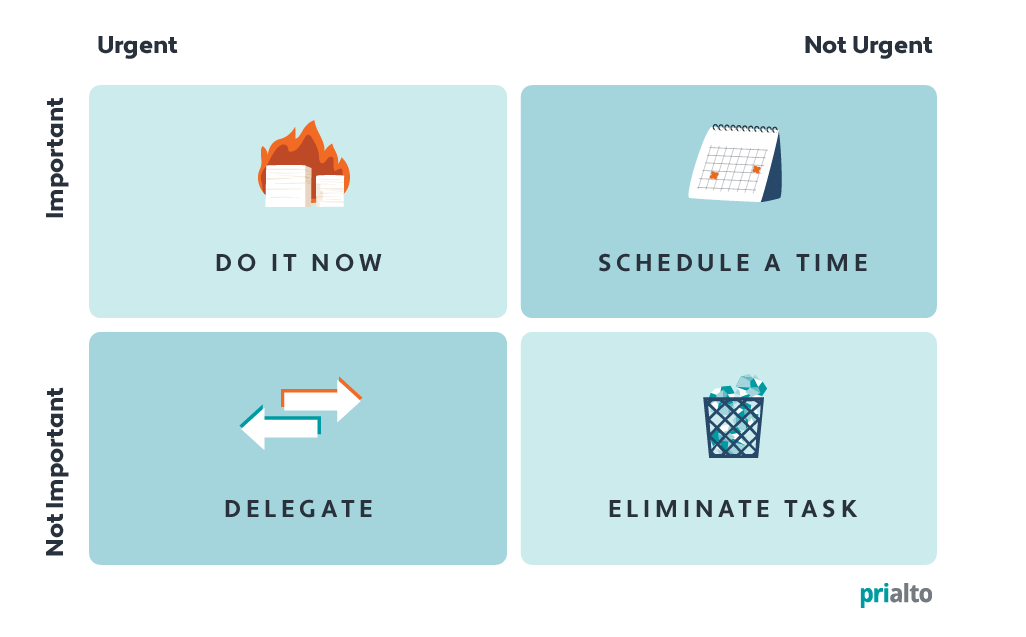
Break tasks into four categories:
- Important, urgent
- Important, not urgent
- Not important, urgent
- Not important, not urgent
Prioritize setting time for the important, urgent tasks. Schedule time for important, not urgent tasks, and delegate the rest.
You can also use a quick Eisenhower Matrix to understand the urgency of distractions — so you only break out of a focus block if it's of vital importance.
Failing to prioritize is one of the biggest reasons the Pomodoro Method fails.
How a Managed Assistant Keeps the Pomodoro Method Running
If the interruption protocol is the method's weak point, the fix is to hand that protocol to someone else.
A Prialto virtual assistant can run, inform, negotiate, schedule, and call back for you. While your timer runs, your assistant lets people know you're heads-down, proposes a better time, books it, and flags anything that truly can't wait. You stay focused, and the people around you still get a timely response.
Your assistant can support the rest of the cycle, too:
- Planning: drafting tomorrow's To Do Today list from your calendar, open threads, and upcoming deadlines
- Protecting: blocking two-hour focus windows on your executive calendar (four pomodoros plus a long break) and defending them from new meeting requests
- Batching: triaging your inbox during your sprints and handing you a short, prioritized batch at each long break
- Recording: tracking completed pomodoros and noting where your estimates consistently run long
Because Prialto is a managed service, that support doesn't disappear when someone takes a vacation. Trained backup assistants and a dedicated Engagement Manager keep your system running, so the habit you build this quarter still holds next year.
Learn more about Prialto's managed virtual assistant service →
Pomodoro Method: Frequently Asked Questions
Does the Pomodoro technique work?
For most people, yes. Research on students links fixed Pomodoro-style breaks to lower fatigue and fewer distractions than self-timed breaks. The technique works best on tasks you can finish or meaningfully advance in 25-minute blocks, and less well when your day is driven by incoming requests.
Why is it called the Pomodoro technique?
Pomodoro means tomato in Italian. Francesco Cirillo named the method after the tomato-shaped kitchen timer he used as a university student in the late 1980s.
Is 25/5 or 50/10 better for the Pomodoro method?
The classic 25/5 split is the best starting point, especially if you struggle to get started or get distracted easily. Many people shift to 50/10 for deep work like writing or analysis, where 25 minutes can end right as focus peaks. The best interval is the one you can protect consistently.
What's the difference between the Pomodoro technique and timeboxing?
The Pomodoro technique uses identical, fixed intervals with built-in breaks, regardless of the task. Timeboxing gives each task its own time limit based on how long it should take. Many executives combine the two: they timebox a project on the calendar, then work through that block in pomodoros.
Ready to Protect Your Focus Time?
The Pomodoro method gives you a structure for focused work. What it can't give you is someone to field everything that arrives while the timer runs. Talk to us about how a Prialto assistant can handle the inbound so your next 25 minutes stay yours.